Home / Psychosocial kits / Retail & Customer Service
Built for retail & customer service

Psychosocial hazard kits for retail and customer service
Already done for you.

Not a generic template. Our psychosocial hazard kits for retail and customer service are built around the risks that actually show up across Australian retail and customer service workplaces — a researched risk assessment for each of the 17 psychosocial hazards, plus a matrix of 200+ risks for your workplace. Over 500 hours of work, already done.

Instant email delivery 100% editable 20+ industries
Psychosocial hazard kit for retail and customer service — busy shopping arcade

This Digital Compliance Kit is specifically designed for Australian small to medium businesses.


85%Done for you before you open it
500+Hours of work you skip
17Hazard categories covered
50+SOPs & policies pre-filled
The deadline already passed

Psychosocial hazard duties are enforceable in every state and territory

Since 1 December 2025, every Australian jurisdiction has enforceable obligations to identify, assess and control psychosocial hazards. From 1 July 2026, NSW businesses must comply with the approved Code of Practice — or prove an equivalent standard.

"We have a good culture" doesn't appear in a WHS audit trail. Risk assessments, control plans and review logs do.

What's inside the retail and customer service psychosocial hazard kits

The risk kit is over 500 hours of research and writing, already done. The SOPs & policies kit is 200+ hours — the controls, written down and ready to issue. Buy what you need or together. Delivered by email as editable files.

Risk assessments kit

17 assessments · 100+ pages

500+ hours of research and writing, done

  • A complete risk assessment for each of the 17 psychosocial hazards
  • 5–6 pages each — hazard, rating and controls pre-filled
  • A matrix of 200+ researched risks for your industry
SOPs & policies kit

50+ SOPs & Policies · 150+ pages

200+ hours of research and writing, done

  • 50+ pre-filled SOPs and policies to edit, adjust or implement as they are
  • The crucial policy documentation supporting your compliance
  • Manager training and implementation guide
In both kits

Buy either kit and these come with it.

Hierarchy of controls training

A full training pack for psychosocial hazards. $299 value

90-day pathway

A guided pathway to get your business compliant in 90 days or less.

See the real thing

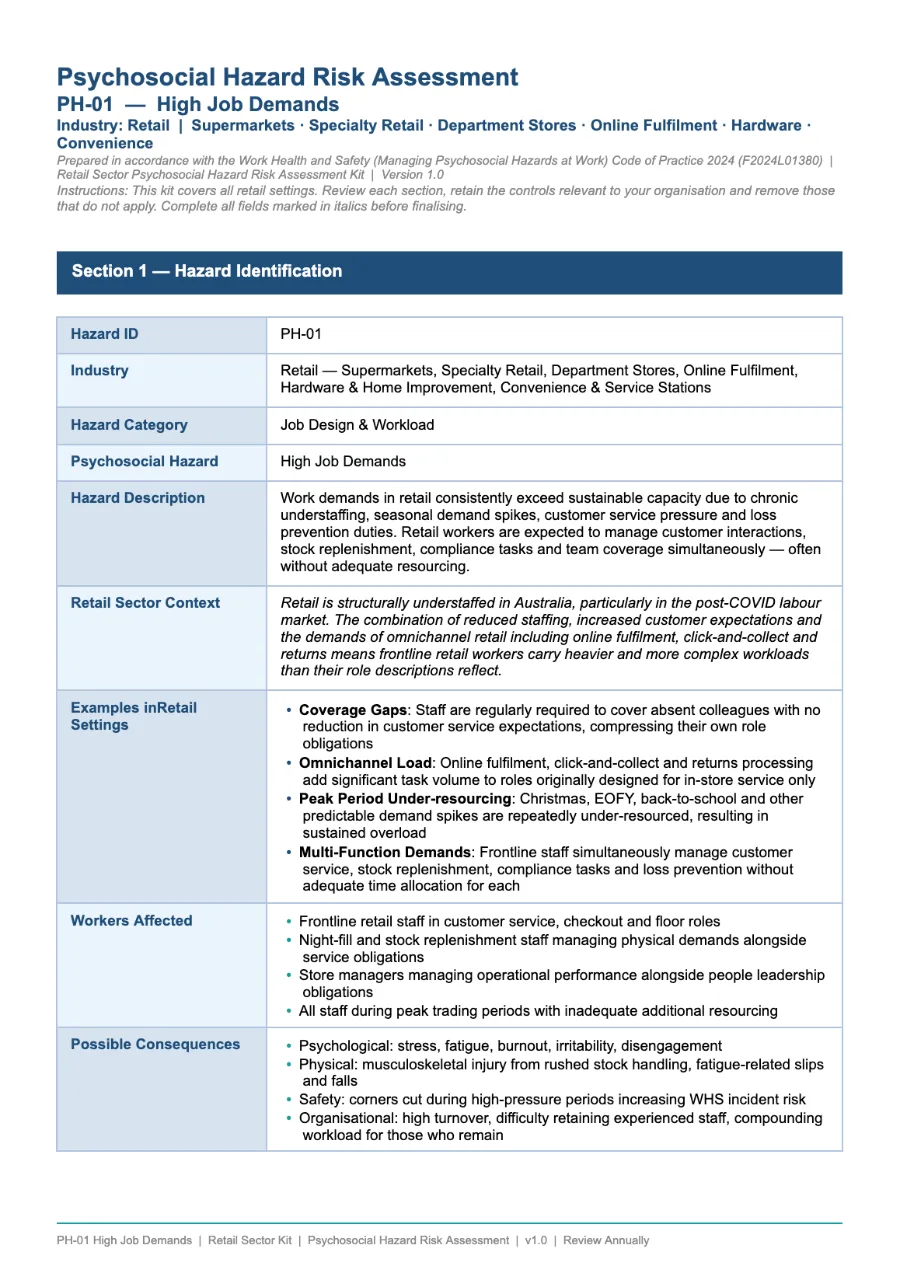
Inside a retail psychosocial risk assessment

This is page 1 of 6 for the first psychosocial risk in the retail kit — PH-01, High Job Demands. Hazard, exposure, rating, controls and actions, all filled in.

Retail psychosocial hazard kit — PH-01 High Job Demands risk assessment, page 1
What you're looking at
Hazard already written up
In site language, not HR language.
Risk already rated
Likelihood × consequence, matrix included.
Controls already chosen
Higher-order first, the way regulators expect.
Actions already prioritised
Owner and due-date columns ready to fill.

Every SafeWize Risk Assessment Kit contains 17 of these documents, each one written for retail and customer service. Download PH-01 High Job Demands and see for yourself.

Download sample risk assessment

Starting from scratch

×Research and identify hazards
×Write 17 risk assessments
×Build control measures
×Develop training content
×Work out where to start and in what order

500+ hours of work

After SafeWize

Hazards already identified for retail and customer service
17 risk assessments written and rated
A matrix of 200+ researched risks for your industry
Hierarchy of controls training included
90-day pathway to compliance

An afternoon of editing

Choose your kit

Two kits: retail, and customer service.

The retail kit covers every kind of shopfront — supermarkets, petrol stations, clothing, stationery and the rest. The customer service kit covers contact centres and service desks, where the pressure is call volume and abuse rather than floor trade.

Start here if you run the business

Retail & customer service sector kit

For owners, store, centre and area managers across all retail formats and customer service teams. 17 hazard categories written around frontline customer work — customer aggression, lone work, roster churn, theft exposure.

Get the sector kit

Choose the one that fits your workplace

Not listed? We will build it. Purchase the industry kit and we will build yours for you.

Request your kit

Why an industry-specific psychosocial hazard kit matters

Regulators expect controls based on the actual risk profile of the work — not generic statements. A template that could belong to any business is exactly what fails an audit.

Retail kit covers
Customer aggression and abuse
Exposure to theft and robbery
Lone work in small-format stores
Unpredictable rostering and short shifts
Repetitive low-control work
Escalation during peak trade
A generic template covers
"Workload"
"Bullying and harassment"
"Poor support"
"Refer to the EAP"

Nothing an inspector can't see through.

Coming November 2026

Buying a kit now costs you nothing later.

Our full compliance system launches in November 2026. The $699 you spend on a kit today comes off it in full — so there's no reason to wait out your obligations.

Today
$699 — risk assessment kit

Done for you. 500+ hours of work you skip, documentation ready this week.

November
Upgrade to the full system

The complete compliance system — with your full $699 credited toward it.

Launch offer — first 100 businesses

$699 — half price, for the first 100.

Plus bonus resources included free while the launch runs.

"Hard Conversations" workplace poster
Worker consultation survey pack
Retail industry kit
$699

Launch price, 50% off. One-time payment, instant email delivery.

Claim my launch price

Offer ends once 100 businesses are in.

Psychosocial hazard requirements for Australian retail and customer service businesses

Under the model Work Health and Safety Regulations, a person conducting a business or undertaking must identify psychosocial hazards, eliminate the risk so far as is reasonably practicable, and where elimination is not possible, minimise the risk using control measures. Since 1 December 2025 these duties have been enforceable in every Australian state and territory. From 1 July 2026, NSW businesses must comply with the approved Code of Practice: Managing psychosocial hazards at work or demonstrate an equivalent standard.

Regulators expect control measures based on the actual risk profile of the work. Generic statements do not satisfy the duty, and higher-order controls that change the work itself are preferred over controls that ask the worker to cope. For a retail or customer service business, this means the assessment must address the hazards that arise in your workplace rather than describing workplace stress in the abstract.

Psychosocial hazards specific to retail and customer service

Retail work places psychosocial risk at the counter. Customer aggression and abuse is the dominant reported hazard, and it has risen materially since 2020 across grocery and frontline retail. Lone work in small-format stores, fuel and convenience removes any immediate support when an incident occurs, and also raises exposure to theft and robbery. Rostering practices — short shifts, late notice, split availability — reduce a worker's control over their own week, which is a recognised psychosocial hazard in its own right rather than merely an inconvenience. Much retail work is also repetitive and closely prescribed, a combination of high demand and low control that the evidence links directly to psychological harm.

Customer service work concentrates the same hazard in a different setting. Contact centre and service desk staff absorb abuse at volume, with no physical distance and often no ability to end a call, and the exposure is continuous rather than occasional. Scripting and quality frameworks remove discretion over how a difficult interaction is handled, which is a recognised low-job-control hazard. Call monitoring, adherence targets and after-call work compress recovery time between contacts, and performance dashboards make the pressure visible and personal. Because the work is done sitting at a screen, the psychological load is frequently underestimated in risk assessments that focus on physical hazards.

The 17 psychosocial hazards covered

SafeWize retail and customer service kits include a separate risk assessment for each recognised psychosocial hazard, approximately 5 to 6 pages per hazard, with the hazard described in your industry's language, the risk rated, and controls selected and mapped to the hierarchy of controls. The full list is set out on the psychosocial kits page.

What documentation a regulator asks for

In a WHS investigation, documentary evidence determines the outcome. Inspectors typically ask for the psychosocial risk assessment, the control measures selected and their position in the hierarchy of controls, evidence of worker consultation, and records showing controls have been reviewed. A statement that the workplace culture is positive is not a defence and does not appear in an audit trail.

Authoritative sources

The obligations described on this page come from the model WHS Regulations and the psychosocial hazards Code of Practice. The primary sources are published by Safe Work Australia and the state and territory regulators:

Your regulator: SafeWork NSW · WorkSafe Victoria · WorkSafe Queensland · SafeWork SA · WorkSafe WA · WorkSafe Tasmania · WorkSafe ACT · NT WorkSafe · Comcare (Commonwealth)

SafeWize is not a regulator. The kits are compliance documentation, not legal advice. Always check the current requirements with the regulator in your jurisdiction.

Psychosocial hazard kits for retail and customer service — FAQs

Is a psychosocial risk assessment compliant in my state?

The kits are built to the model WHS framework and the psychosocial hazards Code of Practice, which every Australian state and territory now enforces. Enforceable psychosocial duties have applied nationally since 1 December 2025, and NSW businesses must comply with the approved Code of Practice, or demonstrate an equivalent standard, from 1 July 2026.

How much work is left for me to do?

Roughly 15 per cent. You delete what does not apply to your workplace, add your business name and sign off on the controls. Most businesses finish a kit in an afternoon.

Do I still need a WHS consultant?

Not to produce the documentation. The kits provide the risk assessments, the controls matrix, the SOPs and the policies a regulator asks for, which is the part consultants normally bill 500 or more hours to write.

Why does the kit need to be specific to retail and customer service?

Regulators expect control measures based on the actual risk profile of the work rather than generic statements. Retail work places psychosocial risk at the counter. A template that could belong to any business is the kind of document that fails an audit.

Should I wait for the full compliance system?

No. Psychosocial duties are already enforceable. Buy either kit now and the full amount you paid is credited against the SafeWize compliance system when it launches in November 2026.

Stop starting from scratch.

Done for you. Not generic templates.

Get the retail & customer service kit