Under the model Work Health and Safety Regulations, a person conducting a business or undertaking must identify psychosocial hazards, eliminate the risk so far as is reasonably practicable, and where elimination is not possible, minimise the risk using control measures. Since 1 December 2025 these duties have been enforceable in every Australian state and territory. From 1 July 2026, NSW businesses must comply with the approved Code of Practice: Managing psychosocial hazards at work or demonstrate an equivalent standard.
Regulators expect control measures based on the actual risk profile of the work. Generic statements do not satisfy the duty, and higher-order controls that change the work itself are preferred over controls that ask the worker to cope. For media, creative and marketing businesses, this means the assessment must address the hazards that arise in your workplace rather than describing workplace stress in the abstract.
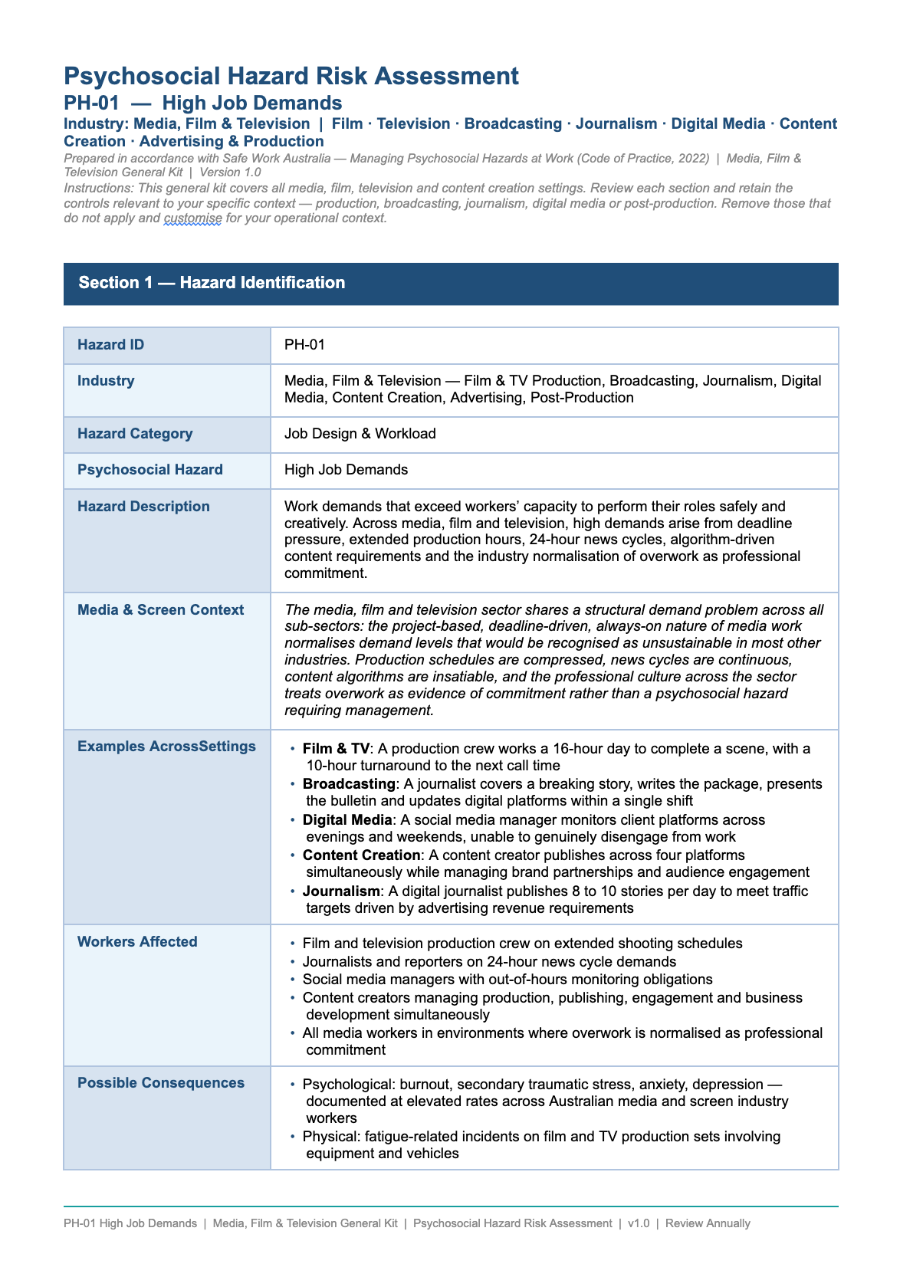
Film and television production concentrates the hazard in working time. A crew completing a scene may work a sixteen-hour day and then receive a ten-hour turnaround to the next call time, which leaves no genuine recovery once travel is counted. Fatigue at that level produces physical incidents as well as psychological harm, because the work involves rigging, equipment and vehicle movement on live sets. Production is also project-based: the income stops when the shoot wraps, so crew accept demand levels they would otherwise refuse in order to stay engaged for the next production. Schedule compression driven by budget or weather is treated as an operational fact rather than a hazard requiring control, which is precisely the position the model WHS framework rejects.
Broadcasting and journalism carry a continuous rather than cyclical demand. A journalist may cover a breaking story, write the package, present the bulletin and update digital platforms inside a single shift, with traffic targets set by advertising revenue rather than by editorial capacity. The material itself is a recognised exposure: reporters and producers review distressing footage and interview people in crisis as ordinary work, and vicarious traumatic stress is documented at elevated rates across Australian media workers. Because bylines and on-air presence are public, abuse arrives directed at the named individual rather than at the organisation, and it does not stop at the end of a shift. Each of these is a psychosocial hazard the regulator expects to see assessed and controlled, not absorbed as part of the job.
Psychosocial hazards specific to media, creative and marketing businesses
Media, creative and marketing work makes psychosocial risk structural rather than incidental. Deadlines are external and immovable while scope is negotiable only downward, so revision cycles absorb the slack in personal time. Criticism of creative work is inherently subjective, which makes it harder to bound than criticism of a measurable output, and client escalation frequently arrives without a defined resolution path. A large share of the workforce is freelance or contract, so declining work or raising workload risks the next engagement. Journalists, content moderators and production staff encounter distressing material as routine content, and unlike emergency services the sector rarely has structured debriefing. Published work also attracts public and online abuse directed at named individuals, a hazard that follows the worker outside working hours.
The 17 psychosocial hazards covered
SafeWize media, film and television kits include a separate risk assessment for each recognised psychosocial hazard, approximately 5 to 6 pages per hazard, with the hazard described in your industry's language, the risk rated, and controls selected and mapped to the hierarchy of controls. The full list is set out on the psychosocial kits page.
What documentation a regulator asks for
In a WHS investigation, documentary evidence determines the outcome. Inspectors typically ask for the psychosocial risk assessment, the control measures selected and their position in the hierarchy of controls, evidence of worker consultation, and records showing controls have been reviewed. A statement that the workplace culture is positive is not a defence and does not appear in an audit trail.
Authoritative sources
The obligations described on this page come from the model WHS Regulations and the psychosocial hazards Code of Practice. The primary sources are published by Safe Work Australia and the state and territory regulators:
Your regulator: SafeWork NSW · WorkSafe Victoria · WorkSafe Queensland · SafeWork SA · WorkSafe WA · WorkSafe Tasmania · WorkSafe ACT · NT WorkSafe · Comcare (Commonwealth)
SafeWize is not a regulator. The kits are compliance documentation, not legal advice. Always check the current requirements with the regulator in your jurisdiction.