Under the model Work Health and Safety Regulations, a person conducting a business or undertaking must identify psychosocial hazards, eliminate the risk so far as is reasonably practicable, and where elimination is not possible, minimise the risk using control measures. Since 1 December 2025 these duties have been enforceable in every Australian state and territory. From 1 July 2026, NSW businesses must comply with the approved Code of Practice: Managing psychosocial hazards at work or demonstrate an equivalent standard.
Regulators expect control measures based on the actual risk profile of the work. Generic statements do not satisfy the duty, and higher-order controls that change the work itself are preferred over controls that ask the worker to cope. For an automotive business, this means the assessment must address the hazards that arise in your workplace rather than describing workplace stress in the abstract.
Psychosocial hazards specific to automotive and auto services
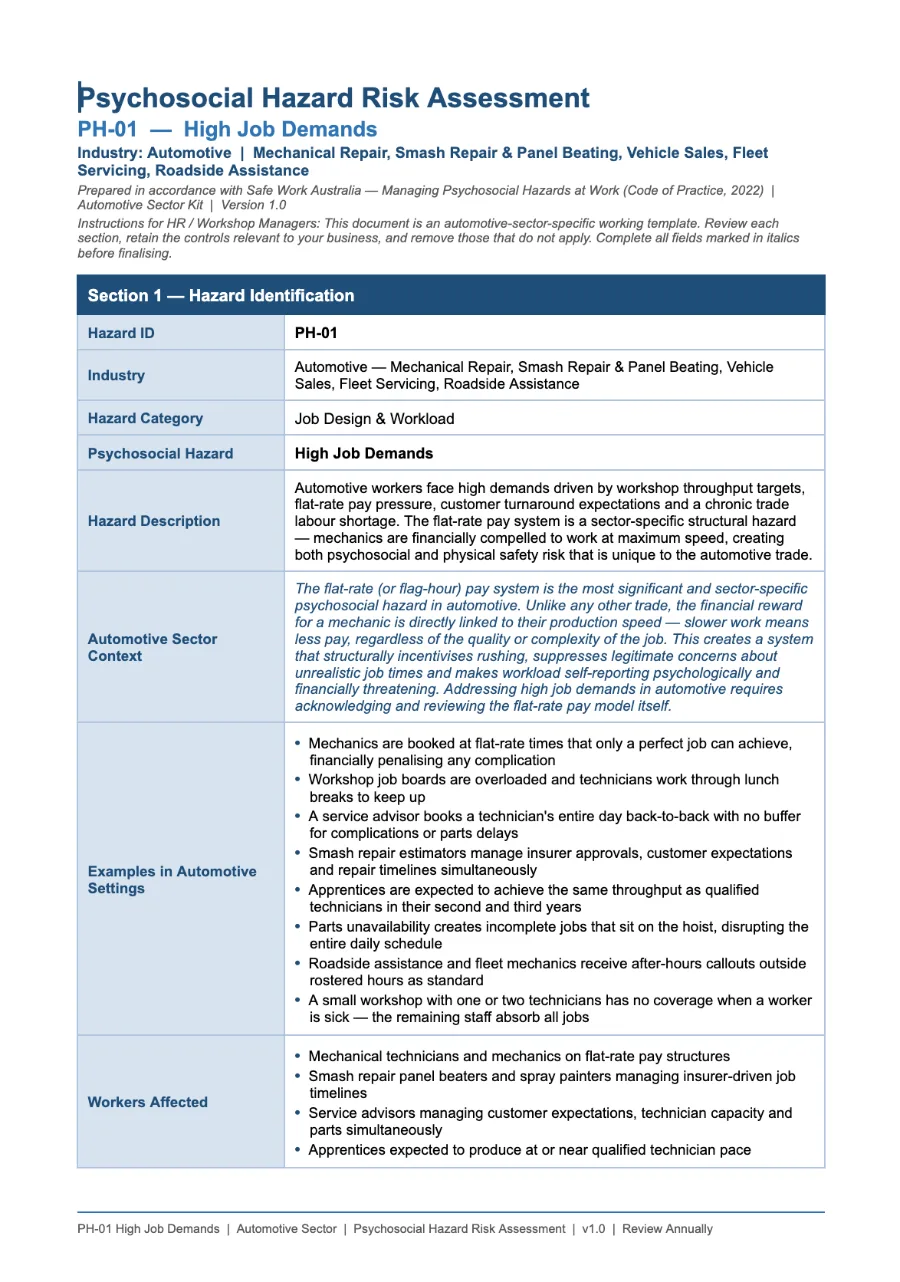
Automotive work builds psychosocial risk into how the work is paid. Flat-rate and billable-hour systems transfer commercial risk to the technician, so a difficult job becomes a personal financial loss — a structural high-demand, low-control arrangement rather than an attitude problem. Customer conflict over cost, diagnosis and delay is a routine feature of service work, and staff at the counter absorb it with little authority to resolve it. Parts and supply delays sit outside the workshop's control while the customer expectation does not move. The trade also carries a well-documented apprentice risk: young workers in hierarchical workshops experience bullying and hazing at rates above the general workforce, and are least likely to report it.
The 17 psychosocial hazards covered
SafeWize automotive kits include a separate risk assessment for each recognised psychosocial hazard, approximately 5 to 6 pages per hazard, with the hazard described in your industry's language, the risk rated, and controls selected and mapped to the hierarchy of controls. The full list is set out on the psychosocial kits page.
What documentation a regulator asks for
In a WHS investigation, documentary evidence determines the outcome. Inspectors typically ask for the psychosocial risk assessment, the control measures selected and their position in the hierarchy of controls, evidence of worker consultation, and records showing controls have been reviewed. A statement that the workplace culture is positive is not a defence and does not appear in an audit trail.
Authoritative sources
The obligations described on this page come from the model WHS Regulations and the psychosocial hazards Code of Practice. The primary sources are published by Safe Work Australia and the state and territory regulators:
Your regulator: SafeWork NSW · WorkSafe Victoria · WorkSafe Queensland · SafeWork SA · WorkSafe WA · WorkSafe Tasmania · WorkSafe ACT · NT WorkSafe · Comcare (Commonwealth)
SafeWize is not a regulator. The kits are compliance documentation, not legal advice. Always check the current requirements with the regulator in your jurisdiction.